Visibility first
Perimeter events, endpoint telemetry, and LAN-side observations provide different views of the same activity.
Public SOC architecture
SynapticSOC connects perimeter, endpoint, and passive network visibility into a single operational workflow designed around evidence quality, structured triage, and human-reviewed decisions.
Architecture objective
The architecture is designed to improve the quality of security decisions by combining multiple observations before recommending action. Each component has a defined operational role.
Perimeter events, endpoint telemetry, and LAN-side observations provide different views of the same activity.
Graylog, OpenSearch, and n8n combine context before an analyst decision or response recommendation is recorded.
Automation supports triage and evidence handling without replacing analyst judgment.
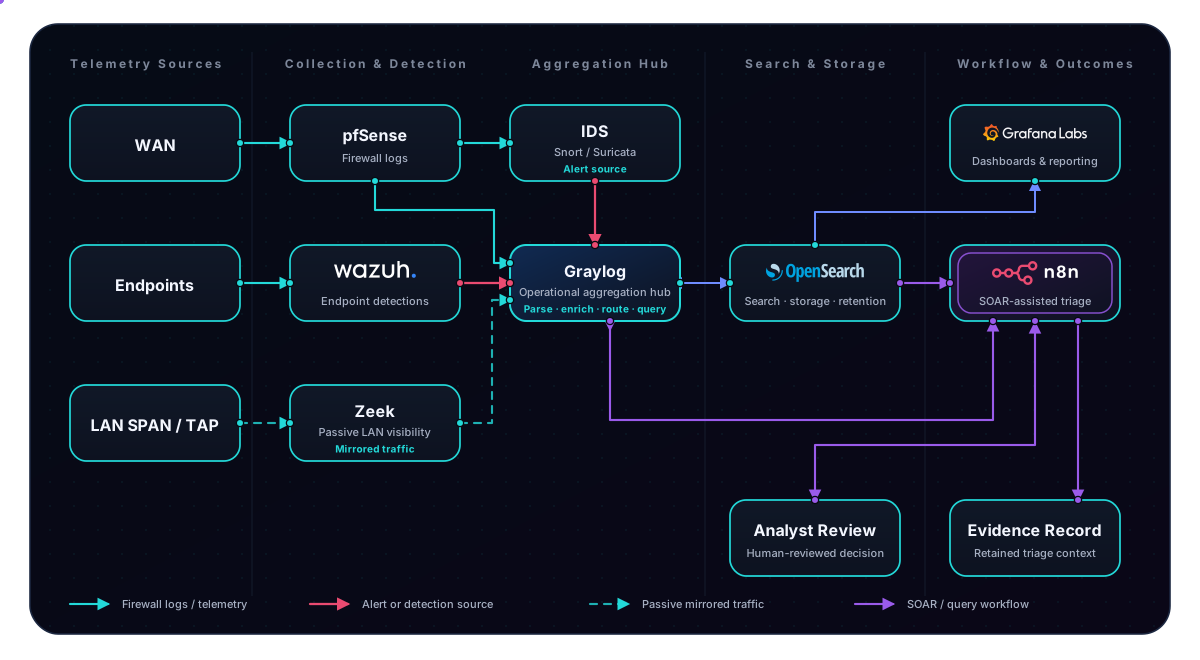
Public high-level data flow
This public diagram describes the main architectural relationships while intentionally excluding sensitive implementation details.
System layers
The system is structured as connected layers rather than a single monolithic security platform.
pfSense · Snort · Suricata
Perimeter traffic, firewall decisions, and IDS alerts provide the first layer of network-security visibility.
Wazuh agents
Endpoint telemetry provides host events, security detections, inventory context, and supporting evidence.
Switch SPAN / TAP · Zeek
Zeek passively observes mirrored LAN traffic to help determine whether network activity reached an internal endpoint.
Graylog
Graylog acts as the central operational hub for normalizing, enriching, routing, searching, and presenting security context.
OpenSearch
OpenSearch supports indexed search, retained telemetry, and historical investigation across the wider SOC workflow.
n8n · Graylog · OpenSearch
n8n exchanges context with Graylog and OpenSearch to support enrichment, triage, alerting, acknowledgment, and evidence recording.
Analyst review · Evidence record
The analyst remains responsible for interpreting evidence, confirming the event, and deciding whether response is justified.
Grafana
Grafana presents selected operational and reporting views from stored and processed data.
Operational flow
pfSense, IDS sensors, Wazuh agents, and Zeek provide distinct network and endpoint observations.
Graylog structures and enriches incoming events so evidence from different sources can be compared consistently.
OpenSearch supports indexed search and retained context for investigation, workflow queries, and reporting.
n8n coordinates high-level enrichment, correlation, alerting, acknowledgment, and evidence-recording steps.
Automation supports the decision, but the analyst determines whether observed activity requires a response.
Design principles
The project prioritizes openly available tools and transparent technical decisions.
Automated actions are not enabled simply because a detection fired. Evidence quality and validation come first.
The workflow assists the analyst rather than hiding decisions inside opaque automation.
The architecture reflects real storage, hardware, maintenance, and financial constraints.
Implementation status
SynapticSOC documents what is working today separately from what is still being designed, hardened, or validated.
Implemented and demonstrated
Planned or being hardened
Public disclosure boundary
The public architecture intentionally excludes credentials, tokens, internal addresses, ports, hostnames, firewall rules, Graylog queries, n8n workflow logic, and other implementation details that could increase operational risk.